
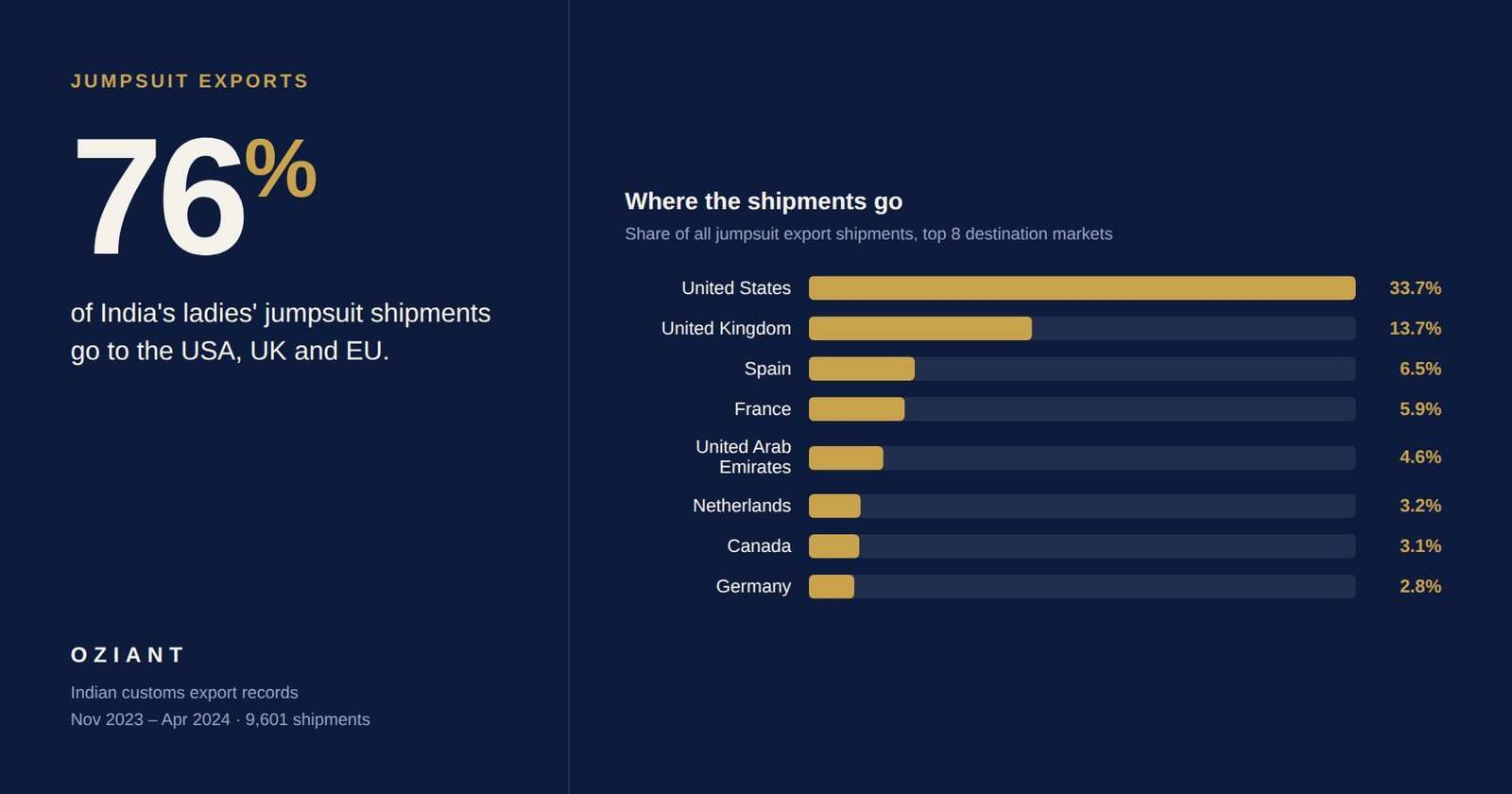
Three out of every four ladies’ jumpsuits that leave India are bound for the United States, the United Kingdom or the European Union. That is not a marketing claim — it is what the shipment records say. We pulled 9,601 Indian customs export records covering jumpsuits and read where every consignment actually went.
What the shipment records show
Across the period we examined, 1,036 Indian exporters shipped jumpsuits to 96 countries. The concentration is striking:
- United States — 33.7% of all shipments. One market takes a third of the trade.
- United Kingdom — 13.7%, the single largest European destination.
- EU — 28.8% combined, led by Spain (6.5%), France (5.9%), the Netherlands (3.2%), Germany (2.8%), Poland and Italy.
- Combined USA + UK + EU — 76.1% of every jumpsuit consignment leaving India.
Median unit values cluster tightly: $9.52 into the United States, $9.37 into the United Kingdom, $9.69 into Germany and $10.01 into Denmark. That is a wholesale price band, not a sampling band — these are production runs, not trial orders.

Why the jumpsuit specifically
The jumpsuit is unusually well suited to the way Indian garment manufacturing is organised, and unusually easy for an overseas buyer to merchandise.
It is one garment, not two. A top-and-trouser set is two patterns, two cutting operations, two size grids and two chances to end the season with mismatched stock. A jumpsuit collapses all of that into a single SKU. For a boutique retailer holding limited open-to-buy, that halves the inventory risk on the same rail space.
It sits in India’s strongest capability band. The dominant classification in the data is HS 6211 — other garments, woven — with meaningful volume also under HS 6209, 6111, 6204 and 6114. These are cut-and-sew woven and light-knit categories where India’s mid-sized units, particularly around Delhi NCR and Tiruppur, are competitive on both make quality and moderate minimum order quantities.
It carries fabric and finish well. Viscose blends, linen-viscose, organic and BCI cotton, and polyester crepe all appear repeatedly in the shipment descriptions. Buyers sourcing to a sustainability brief will find certified-cotton programmes already running rather than needing to be built.
It is season-elastic. Sleeveless and short-sleeve styles carry spring-summer; long-sleeve and heavier weaves carry autumn. The same block runs most of the year, which is why the trade sustains air freight — Delhi Air is the single busiest origin point in the data at 3,576 shipments, ahead of JNPT’s 2,511 by sea. Air freight on a garment this weight only makes sense for replenishment against live sell-through.

The tariff position changed in July 2026
Two policy changes landed within ten days of each other, and both moved in India’s favour. Anyone still working from a 2025 landed-cost model is pricing the wrong number.
United Kingdom — duty went to zero
The India–UK Comprehensive Economic and Trade Agreement entered into force on 15 July 2026. Textile and apparel duties of up to 12% fell to zero across 1,143 tariff lines. For a UK importer landing a $9.37 jumpsuit, that is roughly a dollar a unit off the landed cost — recovered on every unit, from the moment the paperwork is right.
The word “paperwork” is doing real work in that sentence. Preferential rates are not automatic. Your supplier has to issue a valid proof of origin and the goods have to satisfy the agreement’s rules of origin. Ask for this in writing before the order is confirmed, not when the container is on the water.
United States — India sits in the lower tariff band
From 24 July 2026, the US Section 301 action places India at 10%, while China, Vietnam, Thailand, Türkiye, the UAE, Brazil and South Africa sit at 12.5%. On apparel margins, a 2.5-point differential is enough to move a programme.
One honest caveat, because much of the coverage has skipped it: this is not a blanket advantage. Bangladesh, Cambodia, Pakistan, Sri Lanka, Indonesia and Malaysia are also at 10%. India’s gain is specifically against China and Vietnam — which happens to be exactly where most US jumpsuit programmes have historically been placed. Against Dhaka, you are competing on make quality, MOQ flexibility and lead time, as you always were.
European Union — still at MFN
The India–EU free trade agreement is not in force. EU importers continue to pay standard MFN duty on Indian apparel. Anyone quoting you duty-free entry into the EU today is wrong. Negotiations point to early 2027; until it is signed and ratified, price the duty in.
What to check before you place the order
- Confirm the HS classification for your actual garment. Jumpsuits scatter across 6211, 6204, 6104, 6114 and 6111 depending on construction, fibre and whether the wearer is an adult or a child. The code sets your duty rate, so settle it before costing, not after.
- Get the proof of origin commitment in writing if you are importing into the UK. No valid origin documentation means no preferential rate — you simply pay the old duty.
- Separate MOQ per style from MOQ per colour. A supplier quoting 300 pieces may mean 300 per colourway, which is a materially different order.
- Decide air versus sea deliberately. Delhi Air dominates this trade for a reason, but the freight differential on a light garment can exceed the tariff saving you just negotiated.
- Ask for fabric composition and certification up front — organic, BCI, OEKO-TEX. Retrofitting a certification claim after production is not possible.
Where to find the manufacturers
OZIANT lists Indian manufacturers screened from customs export records — companies that have actually shipped the goods, ranked by export shipment count and destination-market spread, not by who paid for placement.
- Top 10 Verified Women’s & Kids’ Apparel Manufacturers in India — the core jumpsuit and woven-garment exporters.
- Top 10 Verified Crop Tops & Knitwear Manufacturers in India — for buyers building a coordinated range.
- HS Code 6204 — women’s woven garments, with duty positions by destination market.
- Buy apparel from India — United States and United Kingdom.
Contact details for listed manufacturers are released by e-mail against a buyer request — we do not publish supplier phone numbers or e-mail addresses, and we cap how many suppliers receive any one enquiry so the responses you get are considered rather than automated.
Post your requirement and we will match it against verified Indian manufacturers in this category.
About the data. Shipment figures are drawn from Indian customs export records covering 9,601 jumpsuit consignments between November 2023 and April 2024, across 1,036 exporters and 96 destination markets. That window predates the July 2026 tariff changes — it describes where demand already sits, not the effect of the new duty positions. Tariff rates are current as at 24 August 2026 and should be verified against the applicable tariff schedule before you commit to a landed-cost model.
One Response