Setting up an export oriented unit in Uttar Pradesh is being sold hard right now. The State cleared a new Export Promotion Policy in September 2025, raised its annual incentive budget roughly six-fold, and wants half again as many registered exporters by 2030. The pitch lands in a lot of inboxes: become a 100% EOU, import duty-free, collect subsidies, export.
Most of what is written about it is a list of benefits with no arithmetic and no obligations. This piece is the other thing. It sets out what a 100% Export Oriented Unit actually gives you under Foreign Trade Policy 2023 in 2026, what Uttar Pradesh adds on top of that, what the scheme costs you in compliance, and — the part almost nobody writes — the two situations in which you should not become an EOU at all.
First, the size of the prize: what Uttar Pradesh actually exports
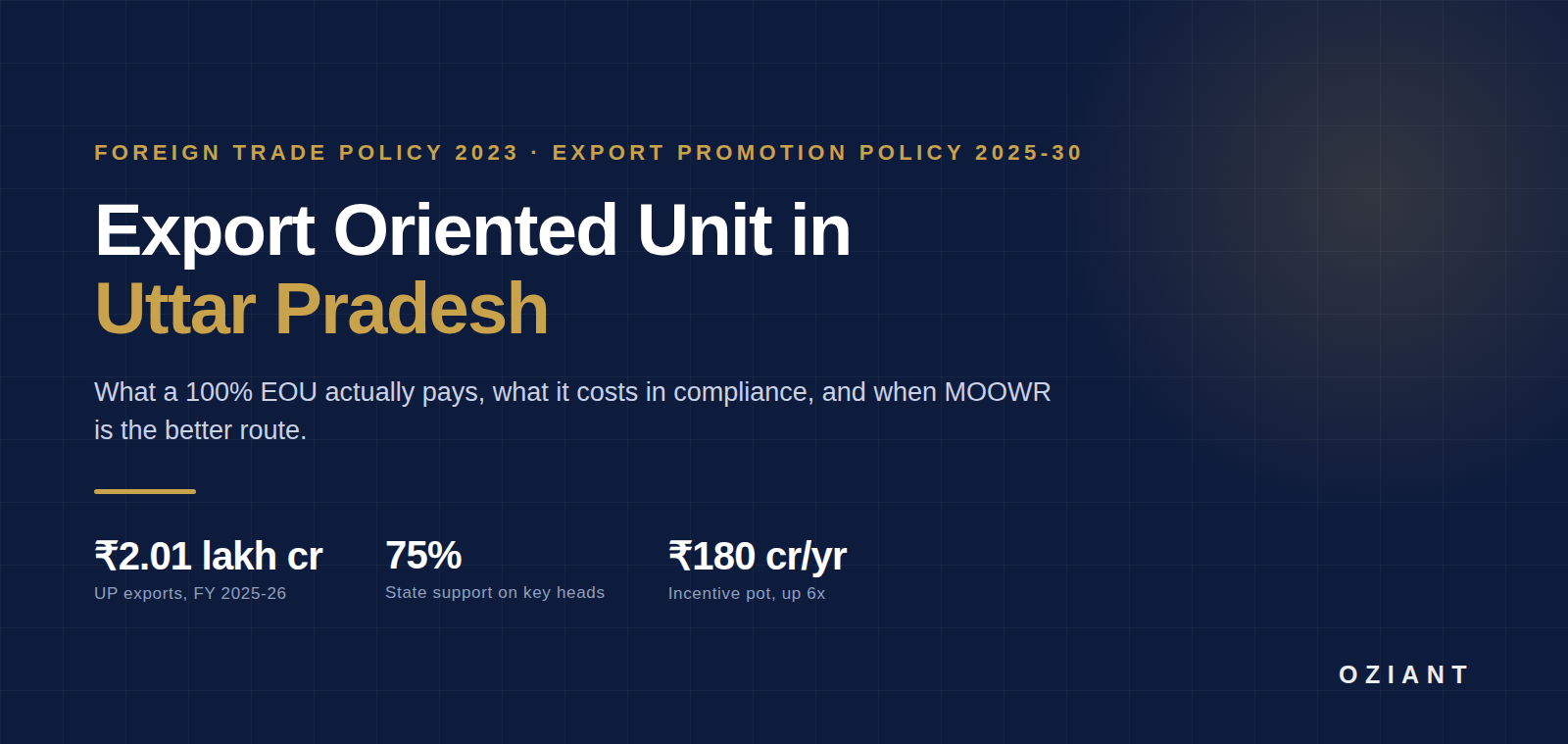
Uttar Pradesh exported about ₹2.01 lakh crore in FY 2025-26, the first time the State has crossed the two-lakh-crore mark. Against India’s ₹39.04 lakh crore that is a 5.2% share. The State’s own target is to take exports from roughly US$21 billion in FY2024 to US$50 billion by 2030, and to grow the registered exporter base by 50%.
The composition matters more than the headline, because it tells you which sectors the administration is actually organised around:
| Product group | FY 2025-26 exports | Note |
|---|---|---|
| Electronics | ₹46,960 crore | Concentrated in Gautam Buddh Nagar |
| Meat and meat products | ₹25,756 crore | Up about 30% |
| Woven garments and apparel | ₹16,657 crore | Lucknow, Kanpur, Barabanki clusters |
| Industrial machinery | ₹10,439 crore | Up about 26%; Kanpur-heavy |
| Footwear | ₹7,731 crore | Agra and Kanpur |
| Leather products | ₹4,634 crore | Up about 16% |
| Silk products | ₹1,507 crore | Up about 156% |
One district does the heavy lifting: Gautam Buddh Nagar alone accounts for ₹97,703 crore, close to half the State’s total, on the back of mobile phones and electronics. Ghaziabad is second, Kanpur Nagar third, then Moradabad and Agra. That concentration is precisely why the 2025-30 policy is written around pulling every district into the export ecosystem rather than adding more support in Noida.
What a 100% EOU gives you in 2026 — and what it stopped giving
The EOU scheme is central, not state. It lives in Chapter 6 of the Foreign Trade Policy 2023, and the same rules apply whether your plant is in Kanpur or Coimbatore. Uttar Pradesh does not run the scheme; it layers its own money on top.
The entitlements that still work
- Duty-free import of capital goods and inputs. Under para 6.01(d) an EOU imports without the basic customs duty leviable under the First Schedule to the Customs Tariff Act, and without additional duty. This is the core of the scheme and it is real money on an import-heavy build.
- Second-hand capital goods with no age limit (para 6.02). Unusual, and genuinely useful if you are buying a used European line for a tannery or a garment unit.
- Domestic suppliers to you are treated as making deemed exports (paras 6.08 and 6.10), so your Indian vendors can claim GST refunds and Chapter 7 benefits. That is a negotiating lever on input prices, not just a paperwork point.
- 100% retention of export earnings in an EEFC account, exemption from industrial licensing, and 100% FDI through the automatic route (para 6.11).
- Bank guarantee waiver for units with turnover of at least ₹5 crore, three years of existence, positive NFE and a clean record — a working-capital saving that compounds.
- Leasing and sale-and-leaseback of capital goods is permitted (para 6.03), and an existing DTA unit can convert into an EOU (para 6.18) rather than building new.
The entitlement that is gone, and the one to verify before you budget
The income tax holiday is over. The Section 10B deduction lapsed for new units and its withdrawal with effect from 1 April 2011 is what triggered the exodus from the scheme in the first place. Anyone still selling EOU status as a route to tax-free profits is working from a fifteen-year-old brochure. What the scheme delivers today is customs and cash-flow advantage, nothing more.
The IGST position needs checking on the day you apply. Exemption from integrated tax and compensation cess on EOU imports has run on Notification 78/2017-Customs and has been extended repeatedly rather than made permanent. Do not put it in a project model on the strength of a blog post — this one included. Ask your customs broker for the operative notification and its current end date before you commit capital.
The obligations nobody puts in the brochure
An EOU is a bonded operation with a permanent export commitment. Four things bind you.
- Minimum investment of ₹1 crore in plant and machinery before you start production (para 6.06). It does not apply to units in handicrafts, agriculture and certain other sectors, or to EHTP/STP/BTP units — which is why software and handicraft units use the scheme more comfortably than mid-size manufacturers.
- Positive Net Foreign Exchange, calculated cumulatively in five-year blocks from the start of production (para 6.04). Exports at FOB minus imports at CIF and other foreign exchange outgo must be positive across the block, not in any one year. A bad two years has to be earned back inside the same block.
- A capped domestic market. DTA sale is allowed but it is an exception, not a channel: service and software units up to 50% of FOB export value or foreign exchange earned, gems and jewellery 10% of the preceding year’s FOB, rejects up to 5%. Everything sold into DTA is on payment of applicable duties and it works against your NFE.
- Bonded premises and continuous monitoring. A legal undertaking, a B-17 bond, customs-bonded premises, and performance monitored by the Units Approval Committee (para 6.19). Exit is possible — a No Dues Certificate from Customs, duty paid on depreciated value, final exit inside seven working days of application (para 6.17) — but it is a process, not a switch.
There is a reason to state this plainly. The scheme’s own record is mixed: EOUs accounted for a peak of around 54% of India’s exports in 2008, fell to about 21% by 2009 and to roughly 4.3% by 2014, with about a fifth of registered units non-functional, after SEZs offered better terms without a domestic sales cap and the tax holiday was withdrawn. Those figures are historical and the policy framework has moved on since, but the lesson has not: the EOU wrapper only pays if your business is genuinely export-first. Bolted onto a business that sells substantially at home, it is a cost centre.
Where a Uttar Pradesh unit applies
You do not apply in Lucknow. EOU approvals for Uttar Pradesh are handled by the Development Commissioner, Noida Special Economic Zone (NSEZ), whose jurisdiction under Appendix 6J covers EOUs and SEZs in Delhi, Uttar Pradesh, Uttarakhand, Punjab, Haryana, Himachal Pradesh, Jammu & Kashmir, Rajasthan, Madhya Pradesh and Chandigarh. NSEZ sits on Noida Dadri Road, Phase II, Gautam Budh Nagar 201305, and runs an online EOU system; the Development Commissioner’s office publishes dc@nsez.gov.in as its contact.
The sequence is: Importer-Exporter Code first, then application to the Development Commissioner, then a Letter of Permission, then the legal undertaking and B-17 bond, then bonding of premises, then production. If you do not yet hold an IEC, start there — our guide to IEC registration covers the documents and the common rejections.
What Uttar Pradesh adds on top: the Export Promotion Policy 2025-30
This is the genuinely new money, and it is where the State’s effort has gone. The Cabinet cleared the Export Promotion Policy 2025-30 on 2 September 2025, replacing the 2020-25 framework. The important number is not in most of the coverage: the State’s annual export incentive spend was raised from roughly ₹25-30 crore a year to about ₹180 crore a year, an additional burden of about ₹882 crore on the State treasury over five years.
Read that as both an opportunity and a constraint. Six times more money is real. It is also a finite pot for an entire state of 240 million people, disbursed against applications. Early, complete, well-documented claims get paid; late ones meet an exhausted head.
Everything below requires registration with the Export Promotion Bureau, Uttar Pradesh — ₹200 for a new registration, ₹100 to renew, valid one year, and it needs a business registered in UP. Silver Card status attaches at ₹20-50 lakh of export turnover, Gold Card above ₹50 lakh.
| Support | Rate | Cap |
|---|---|---|
| Foreign trade fairs — stall | 75% | ₹3.25 lakh per fair, max 3 fairs a year |
| Foreign trade fairs — economy airfare, one person | 75% | ₹1.25 lakh per fair |
| Domestic fairs of international scale | 75% | ₹75,000 stall plus ₹30,000 airfare |
| Virtual trade fairs | 75% | ₹25,000 per fair, max 4 a year |
| Export certifications | 75% | Within the ₹25 lakh overall MDA cap |
| Sample shipments to overseas buyers | 75% | ₹2 lakh a year |
| Publicity, digital cataloguing and digital marketing | 75% | ₹1 lakh a year |
| Onboarding an international e-commerce platform | 75% of first-year fees | ₹3 lakh, one time |
| Freight to gateway port | 30% | ₹20,000 per 20-ft, ₹40,000 per 40-ft; ₹30 lakh a year |
| Air freight | 30% or ₹150/kg, whichever is lower | ₹10 lakh a year |
| Postal exports through Dak Ghar Niryat Kendra | 75% of postage | ₹1 lakh a year |
| Export performance reward | 1% of year-on-year export growth | ₹20 lakh a year |
| ECGC credit insurance premium | 30% | ₹5 lakh a year |
| Export-oriented infrastructure projects (testing labs, warehousing, fulfilment centres) | 40% capital subsidy | ₹10 crore per project |
| All marketing heads combined | — | ₹25 lakh per exporter per year |
Two clarifications worth having. First, the 60%, 50% and 25% rates that still circulate in trade press and consultant decks belong to the 2020-25 policy and are superseded. Second, the widely shared policy PDF carries a “Draft” heading even though the Cabinet has approved the policy and a first amendment has since been issued — work from the notified government order, not the draft, when you file.
Uttar Pradesh has also become the first Indian state to extend marketing development assistance to service exports, with 75% support up to ₹2 lakh for international fair participation — relevant if you run IT services, logistics or medical value travel rather than a factory.
And what UP adds if you are building the plant
Export incentives are separate from investment incentives, and an export oriented unit in Uttar Pradesh can draw on both. Under the Industrial Investment and Employment Promotion Policy 2022 an investor picks one of three mutually exclusive routes: a base capital subsidy multiplied by capacity utilisation and lifted by employment, export and ecosystem boosters; or reimbursement of 100% of net SGST deposited in the State’s account; or a 30% top-up on central PLI incentives capped at eligible capital investment. You choose at application, with one chance to switch after the evaluation committee has processed it.
Stamp duty exemption is explicitly geographic, and it is the single clearest signal of where the State wants factories to go:
| Region | Stamp duty exemption |
|---|---|
| Bundelkhand and Purvanchal | 100% |
| Madhyanchal and Paschimanchal (excluding Gautam Buddh Nagar and Ghaziabad) | 75% |
| Gautam Buddh Nagar and Ghaziabad | 50% |
If you are in textiles or garments — which covers a large share of UP’s export base — the Textile and Garmenting Policy 2022 is usually the better instrument, and it contains one provision aimed squarely at exporters: freight reimbursement for export-oriented units at 75% in years one and two, 50% in years three and four, and 25% in year five. Alongside it sit a capital subsidy of 25% with a 10% regional uplift (capped from ₹1 crore up to ₹100 crore by investment slab), interest subsidy of 60% for seven years capped at ₹1.5 crore a year, an employment subsidy of ₹3,200 per worker per month for five years for mega garment units, 100% electricity duty exemption for ten years, and a 25% land cost subsidy. There is even a startup subsidy of 75% of project cost, capped at ₹20 lakh, specifically for setting up an export house.
The comparison that decides it: EOU, MOOWR or plain DTA
This is the section most articles skip, and it is the one that will save you the most money. An EOU is not the only way to import without paying duty up front.
| 100% EOU | MOOWR (Section 65) | DTA unit claiming RoDTEP | |
|---|---|---|---|
| Customs duty on imports | Exempt | Deferred; waived if the goods are re-exported | Paid up front |
| Export obligation | Yes — positive NFE over five-year blocks | None | None |
| Domestic sales | Capped and duty-paid; hurts NFE | Unlimited; pay duty on clearance | Unlimited |
| Premises | Customs-bonded | Licensed warehouse | Ordinary |
| Oversight | Development Commissioner and Units Approval Committee | Jurisdictional customs, record-keeping | Normal GST and customs |
| Best suited to | Export-first manufacturers with heavy imported inputs | Import-heavy plants selling substantially in India | Low-import, domestic-input exporters |
MOOWR is the one to look at hardest. Manufacturing and Other Operations in Warehouse Regulations, under Section 65 of the Customs Act, lets you defer basic customs duty and IGST on imported capital goods and inputs until the finished goods are cleared into the domestic market — and if they are exported instead, the duty is never paid. There is no export obligation and no NFE test. Section 65A, inserted in 2022, gives the Government power to restrict IGST deferment by notification, and as things stand no such notification has been issued; a 2024 CBIC circular also allows MOOWR to be combined with concessional-rate imports under IGCR. Verify both points before you rely on them.
The practical rule for a Uttar Pradesh manufacturer: if you expect to sell more than about half your output in India, MOOWR almost certainly beats EOU, because you get the cash-flow benefit without the export commitment or the bonded-unit compliance. If you are genuinely export-first with substantial imported inputs, the EOU wrapper plus the State’s subsidies is the stronger package. If your inputs are largely Indian and your import bill is small, neither is worth the overhead — stay a DTA unit and claim RoDTEP and drawback.
The RoDTEP cliff on 30 September 2026
If you are modelling any of the three routes, this is live and it is close. RoDTEP has had a turbulent eighteen months and the current position is precise:
- Notification 35/2025-DGFT of 30 September 2025 kept the scheme in force for DTA units, Advance Authorisation holders, SEZ units and EOUs up to 31 March 2026.
- Notification 60/2025-26 of 23 February 2026 halved rates and value caps across most of Appendix 4R and 4RE, exempting agricultural and food lines under HS Chapters 1 to 24.
- Notification 66/2025-26 of 23 March 2026 reversed that cut and restored the earlier rates.
- Notification 74/2025-26 of 31 March 2026 continued the scheme for all eligible export products from 1 April 2026 to 30 September 2026, holding rates and caps as they stood.
So RoDTEP is notified only to 30 September 2026, with no further extension announced at the time of writing. EOU and SEZ eligibility has moved with successive notifications rather than sitting in one stable rule, so check the operative notification for the shipment window before you assume an EOU consignment earns a rebate. Our explainer on DGFT export schemes tracks how RoDTEP, Advance Authorisation and EPCG interact.
Where in Uttar Pradesh, and for what
The State’s export districts are not evenly matched to the EOU route. Four are worth naming.
- Kanpur Nagar — leather, footwear, saddlery, hosiery and industrial machinery. Around 420 tanning units turning over roughly ₹3,000 crore, some 1,500 footwear units, and a saddlery and harness cluster of about 225 units at roughly ₹400 crore that sells into the USA, UK, France, Italy and Japan. Import-heavy finishing chemicals and machinery make the duty exemption meaningful here.
- Lucknow — chikankari apparel at roughly 6,000 units and 1.35 lakh artisans, plus herbal and ayurvedic products. Mostly domestic inputs, so the EOU maths is weaker; the marketing and freight subsidies matter more than the customs exemption.
- Barabanki — a handloom cluster of about 11,200 weavers that already exports roughly 95% of its output to the Middle East and Europe, alongside a mentha oil cluster of some 5,500 seasonal units. High export intensity, low import intensity.
- Sandila, in Hardoi — an industrial estate of about 1,884 acres with more than ₹5,000 crore of plants operational, weighted to food processing and chemicals. Hardoi is among the State’s fastest-growing export districts, and the Lucknow-Hardoi PM MITRA textile park on about 1,162 acres will add to it.
Two external constraints should shape the destination side of the plan. The India-UK trade agreement in force since 15 July 2026 takes leather from about 16% to zero and textiles from about 12% to zero, subject to rules of origin you have to be able to evidence — see our certificate of origin guide and the trade agreements hub. On the American side, Section 232 duties of 50% on steel, aluminium and copper have no relief, while on most other lines India sits below China and Vietnam — which is why US buyers and UK buyers are the two most active destinations for UP goods right now, with the UAE and Germany behind them. The India-EU agreement is not in force, so treat any EU duty-free claim you are shown as premature.
A worked example
Take a Barabanki handloom exporter, EPB-registered, in a single year: a ₹5 lakh stall at a European trade fair, ₹90,000 of economy airfare, one 40-ft container to the gateway port at ₹90,000 of freight, 500 kg of air-freighted samples costing ₹1.2 lakh, and ₹60,000 of first-year fees on an international e-commerce platform.
| Item | Spend | Basis | Reimbursement |
|---|---|---|---|
| Fair stall | ₹5,00,000 | 75%, capped ₹3.25 lakh | ₹3,25,000 |
| Airfare | ₹90,000 | 75%, capped ₹1.25 lakh | ₹67,500 |
| Sea freight, one 40-ft container | ₹90,000 | 30%, capped ₹40,000 | ₹27,000 |
| Air freight, 500 kg | ₹1,20,000 | Lower of 30% or ₹150/kg | ₹36,000 |
| E-commerce platform, first-year fees | ₹60,000 | 75%, capped ₹3 lakh | ₹45,000 |
| Total | ₹8,60,000 | ₹5,00,500 |
About ₹5 lakh back on ₹8.6 lakh of spend, and none of it depends on being an EOU — it depends on being registered with the Export Promotion Bureau and filing properly. That is the honest order of operations for most UP exporters: take the State money first, and only then work out whether the EOU wrapper earns its compliance.
The checklist
- Get the IEC. Nothing else moves without it.
- Register a business in Uttar Pradesh and register with the Export Promotion Bureau. ₹200. Every State incentive keys off this, and a unit registered outside UP is ineligible however much it exports from a UP factory.
- Model MOOWR against EOU on your own domestic-sales percentage before you approach the Development Commissioner. If more than half your output will sell in India, stop and look at MOOWR.
- Confirm the two perishable items in writing — the operative IGST exemption notification for EOU imports, and RoDTEP eligibility for your shipment window past 30 September 2026.
- Pick your IIEPP route deliberately — capital subsidy with boosters, net SGST reimbursement, or PLI top-up. You get one switch after evaluation, and for a textile or garment unit check the sector policy first.
- Apply to the Development Commissioner at NSEZ for the Letter of Permission, then the legal undertaking, B-17 bond and bonding of premises.
- Diarise the NFE block. Five years, cumulative, from the start of production — track it monthly from day one rather than discovering it in year four.
- File claims early in the financial year. ₹180 crore across the State is generous against the old ₹25-30 crore and finite against 240 million people.
Getting in front of the buyers
Every incentive on this page pays you for something you have already done — a fair you attended, a container you shipped, a platform you joined. None of them finds you a buyer. That is the gap most UP exporters are actually stuck in: the State will reimburse three-quarters of a European trade fair, but only if you can turn the leads into orders once you are standing there.
OZIANT lists Indian manufacturers for overseas wholesale buyers by country and category, with contact details released to registered buyers rather than published. Listing is free to start, and if you are EPB-registered the first-year fees on any paid tier fall under the e-commerce onboarding head in the table above — 75%, capped at ₹3 lakh. You can see how listings appear on our verified manufacturers directory, browse the product categories, or take incoming enquiries through the RFQ desk.
Frequently asked questions
What is the minimum investment for an export oriented unit in Uttar Pradesh?
₹1 crore in plant and machinery before production begins, under para 6.06 of the Foreign Trade Policy 2023. It does not apply to units in handicrafts, agriculture and certain other listed sectors, or to EHTP, STP and BTP units. The threshold is national, not a Uttar Pradesh rule.
Who approves EOU applications for Uttar Pradesh?
The Development Commissioner of Noida Special Economic Zone, whose jurisdiction covers Uttar Pradesh along with Delhi, Uttarakhand, Punjab, Haryana, Himachal Pradesh, Jammu & Kashmir, Rajasthan, Madhya Pradesh and Chandigarh. The Export Promotion Bureau in Lucknow administers the State’s own incentives, not the EOU scheme itself.
Do EOUs still get an income tax exemption?
No. The Section 10B deduction lapsed and its withdrawal took effect from 1 April 2011. Today the scheme delivers customs exemption and cash-flow advantage, not tax-free profits. Any proposal built on an EOU income tax holiday is out of date.
Can an EOU sell in the Indian market?
Within limits and on payment of applicable duties. Service and software units may sell up to 50% of FOB export value or foreign exchange earned; gems and jewellery units up to 10% of the preceding year’s FOB exports; rejects up to 5%. All DTA sales count against the unit’s Net Foreign Exchange position, which must stay positive across each five-year block.
Is MOOWR better than an EOU?
It depends entirely on how much you sell in India. MOOWR defers customs duty and IGST with no export obligation and no NFE test, which suits an import-heavy plant selling substantially at home. An EOU suits an export-first manufacturer with heavy imported inputs, and only that unit also qualifies for the full set of export-linked State supports. As a rough rule, above roughly 50% domestic sales, MOOWR is the stronger route.
What does Uttar Pradesh reimburse for exporters in 2026?
Under the Export Promotion Policy 2025-30: 75% of foreign fair stall costs up to ₹3.25 lakh, 75% of airfare up to ₹1.25 lakh, 75% of certifications, samples and digital marketing, 75% of first-year international e-commerce platform fees up to ₹3 lakh, 30% of gateway port freight up to ₹30 lakh a year, 30% of air freight up to ₹10 lakh, 30% of ECGC premium, and 1% of year-on-year export growth up to ₹20 lakh — all capped at ₹25 lakh per exporter per year across the marketing heads, and all requiring registration with the Export Promotion Bureau.
About the data
Scheme provisions are taken from Chapter 6 of the Foreign Trade Policy 2023 as published by DGFT, and from the Uttar Pradesh Export Promotion Policy 2025-30 as published by the Department of MSME and Export Promotion and Invest UP. Uttar Pradesh trade figures are for FY 2025-26. RoDTEP status is stated as at the DGFT notifications listed above, and the scheme is notified only to 30 September 2026. Historical EOU share-of-exports figures run to 2014 and are cited as history, not as the current position. Customs, GST and DGFT notifications change frequently and several of the items here are explicitly time-limited: this is general information, not tax, customs or legal advice, and you should confirm the operative notification with your customs broker or adviser before committing capital. For the related change in export realisation and reporting rules, see our note on the FEMA 2026 export rule change.